Our first DocIT/DocAI partner meeting is behind us
A day when a document management system became a conversation partner — and the little box sitting in the room stayed switched off the whole time.
Yesterday we held the first joint DocIT/DocAI partner meeting. We deliberately started with a small group: we didn’t want a big event, but a day where genuine conversation could emerge with the people we work alongside every day — the ones whose feedback shapes the system.
Thank you to everyone who came and spent the day with us:
- Duna-Dráva Cement Kft.
- Trigo Kft.
- Digistar Kft.
- IT-shop Kft.
- MEVID Zrt.
- Radioaktív Hulladékokat Kezelő Közhasznú Nonprofit Kft. (Hungarian Public Limited Company for Radioactive Waste Management)
- VANNET Kft.
- BOLKO-Print Kft.
These eight companies are the close inner core of DocIT/DocAI — exactly the circle whose opinion matters most to us right now.
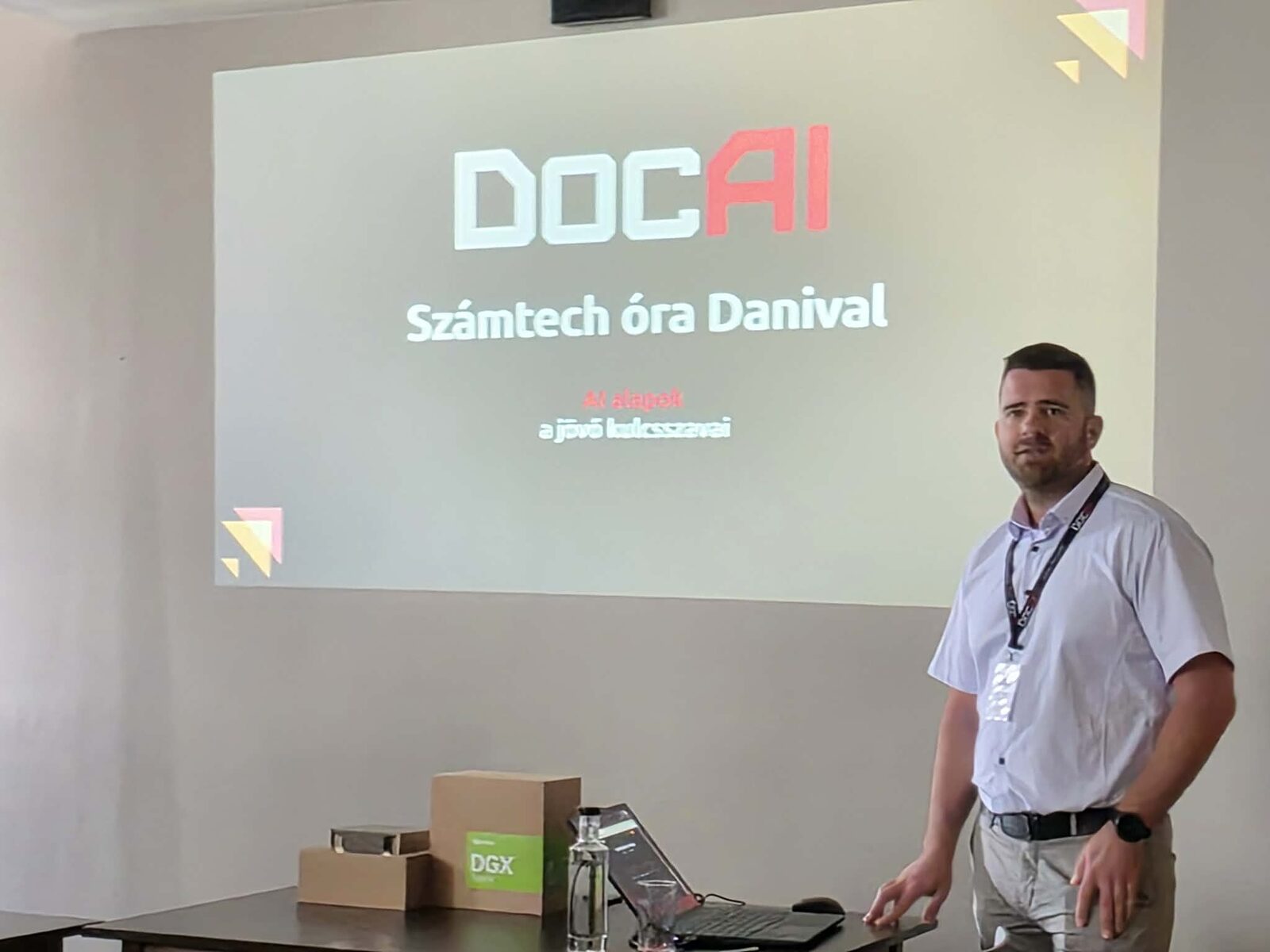
How the day unfolded
The programme deliberately arced from the familiar to the new: we started from the stable, well-known DocIT foundations, and from there worked our way up to asking questions about our own documents by talking to an artificial intelligence.
1. What’s new in DocIT — Zsuzsa Monek
The day began on familiar, solid ground. Zsuzsa walked through what has been renewed in DocIT, which features arrived in the most recent period, and what users can expect in the near future. This is the layer everything else is built on: an organised, searchable, reliably managed document store.
2. Computer science class with Dani — Dániel Kiss
I reserved this block for the most ambitious task: making it clear what lies behind the words “artificial intelligence”, without losing anyone in the jargon. We built the picture up step by step — from the language model (LLM) through fine-tuning (LoRA), asking questions about your own documents (RAG) and tool use (MCP), all the way to the agent, which can already carry a whole workflow through on its own. At each step a live example ran, and when the test “turned green”, everyone could see that this isn’t magic, but well-built, traceable logic.
Lunch break — and this is where the best conversations got going, as they tend to.
3. How DocAI works — Dániel Kiss
After lunch came the heart of it: what DocAI can do in practice today. I showed how it reads the exact fields of a Hungarian invoice or an HR document (KIE — key information extraction), and how it cross-checks them against official sources — with NAV, IM, KOMA and VIES integration. I demonstrated automatic document-type recognition, as well as content generation: the system can also produce marketing material, quotes and draft contracts.
The contract module — comparing contracts against invoices, catching missed periodic billing or discrepancies between contracted and invoiced value — is still under development, so I only flashed it up as a plan, a direction. This will be the next big step, and it’s precisely DocAI’s real differentiator, so I deliberately didn’t promise more of it than is already done.
4. Interactive: DocAI live — Dániel Kiss
The day closed with its most tangible part. On the projector I showed the system live: we went through the pre-prepared test questions, then I handed the floor to the room. The participants called out the questions and tasks, and I ran them right there, live — so everyone could see what the system can do on their own idea. These “spontaneous” questions gave us the best moments of the day, because they probed exactly what a demo script never does.
The machine that ran it all — even though it sat switched off in the room
During the demo there was a moment I deliberately didn’t over-emphasise, yet it’s perhaps the one most people remember. On the table stood an NVIDIA DGX Spark — a box that fits on a desk, yet packs a complete, modern AI server into the footprint that used to belong to a mid-range workstation. Except this unit was switched off the whole time. I only brought it in so people could hold it and grasp how small it really is.
Because what they saw on the projector — the questions, the answers, the live extraction — didn’t come from this machine. That was working somewhere else, quietly, in the server room. And that’s exactly the point: for the user there’s no humming steel cabinet, no separate room, no cloud in the background — just the question and the answer. Meanwhile the documents stay in-house the entire time, and no one needs to come in to reach them. For an accounting firm or a law office, this isn’t a bonus — it’s a baseline requirement.
After months of measurement I can say with a clear conscience: this hardware is more than capable of the job. Every DocAI function runs on it — not on the edge, but with headroom to spare — on a box that fits in a drawer.
What grew out of the conversation: a NIS2 audit module
One of the most valuable outcomes of the day was an idea that took shape during the closing, informal conversation: there was clear demand for a module to support NIS2 compliance and auditing. The NIS2 cybersecurity directive affects more and more Hungarian companies, and compliance places a serious documentation and record-keeping burden on them — exactly the kind of task DocAI is strong at: organising, tracking, and flagging gaps.
The idea was so compelling that we won’t let it fade: the plan is to start building the module this summer. If you’d like to be a partner in this and share your own expectations, we’d be glad to hear from you — the best features have always grown out of real needs.
Thank you
Thank you to everyone who gave us their day. With a first event, you never know in advance whether the atmosphere will come together — this time it did. The questions, the conversations and the after-lunch brainstorming all showed that this format is worth continuing.
See you at the next one — and in the meantime, we’re working on the NIS2 module.
— Dani, DocAI